
 Ruby Ellis

This bookworm bookmark has two deliberately different sections: a short curl of double crochet above the book and a long, narrow chain tail between the pages. It is a small scrap-yarn project, but a clear order of work still matters. This guide separates chain preparation, the thirteen worked points and the drying stages so that the bookmark can be put aside without losing its place. The source calls for approximately 1.2 m of fine yarn and a matching small hook, US size B or similar. The seventy-chain foundation is the reference; no fixed finished length or making time is supplied.
Materials and notation · Complete bookmark instructions · Tail and eyes · Making-session checks
A fine yarn scrap and a small hook
The source calls for approximately 1.2 m of fine scrap yarn and a matching small crochet hook, US size B or similar, plus scissors and a yarn needle. It also specifies 2 tiny wiggle eyes and craft glue. Alternatively, embroider 2 small eyes using contrasting yarn. A numeric hook size in millimetres is not provided, so use the stated size reference rather than treating a guessed conversion as a source measurement.
The approximately 1.2 m yarn length is a source estimate. The exact amount used depends on the selected yarn and how you work. Check your available scrap before starting and keep enough end for secure finishing. No fixed finished length, gauge, fibre or working time is given. The chain count is the technical reference supplied by the source, not a promise that every yarn will produce the same bookmark dimensions.
US crochet terms
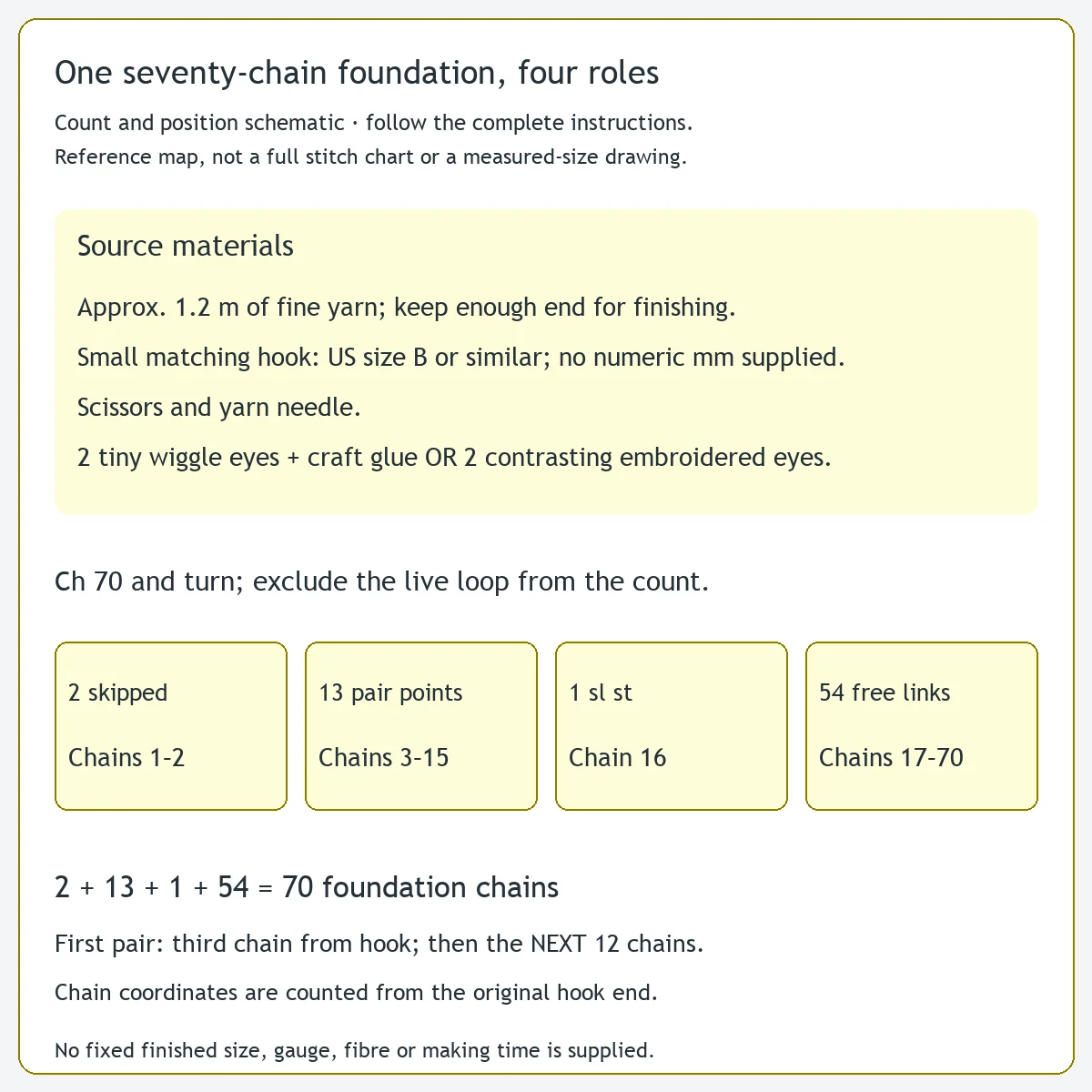
This version uses US terminology. Ch means chain, dc means double crochet and sl st means slip stitch. The loop sitting on the hook is not counted as a chain. When you count back from the hook, locate the completed chain links below that loop. The first worked pair of double crochet stitches goes into the third chain from the hook, not into the active loop or the second chain.
A double crochet pair shares one insertion point: work both stitches into the same chain before moving to the next. The pattern uses thirteen consecutive insertion points, each receiving two double crochet stitches. Count those positions separately from the total number of stitches, so that twenty-six stitches do not become twenty-six worked chains by mistake.
Bookworm bookmark: complete instructions
Begin with seventy chains
Ch 70 and turn the chain. Do not count the loop on the hook. Most of the chain remains free and forms the tail.
Work the short spiral worm
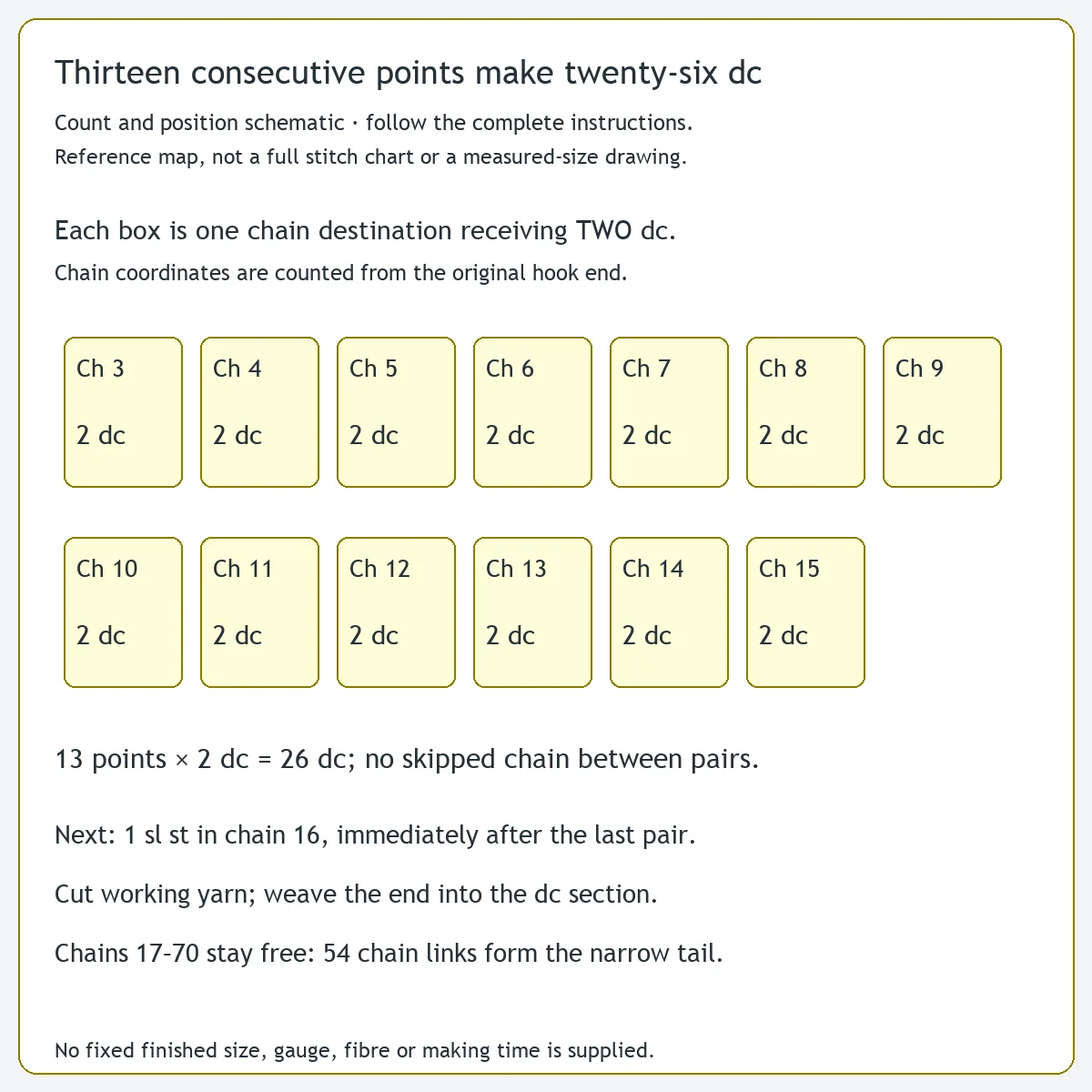
Work 2 dc in the third chain from the hook. Work 2 dc in each of the next 12 chains as well. You now have 26 dc in 13 insertion points. Work 1 sl st in the immediately following chain and cut the working yarn. Weave it into the double crochet stitches.
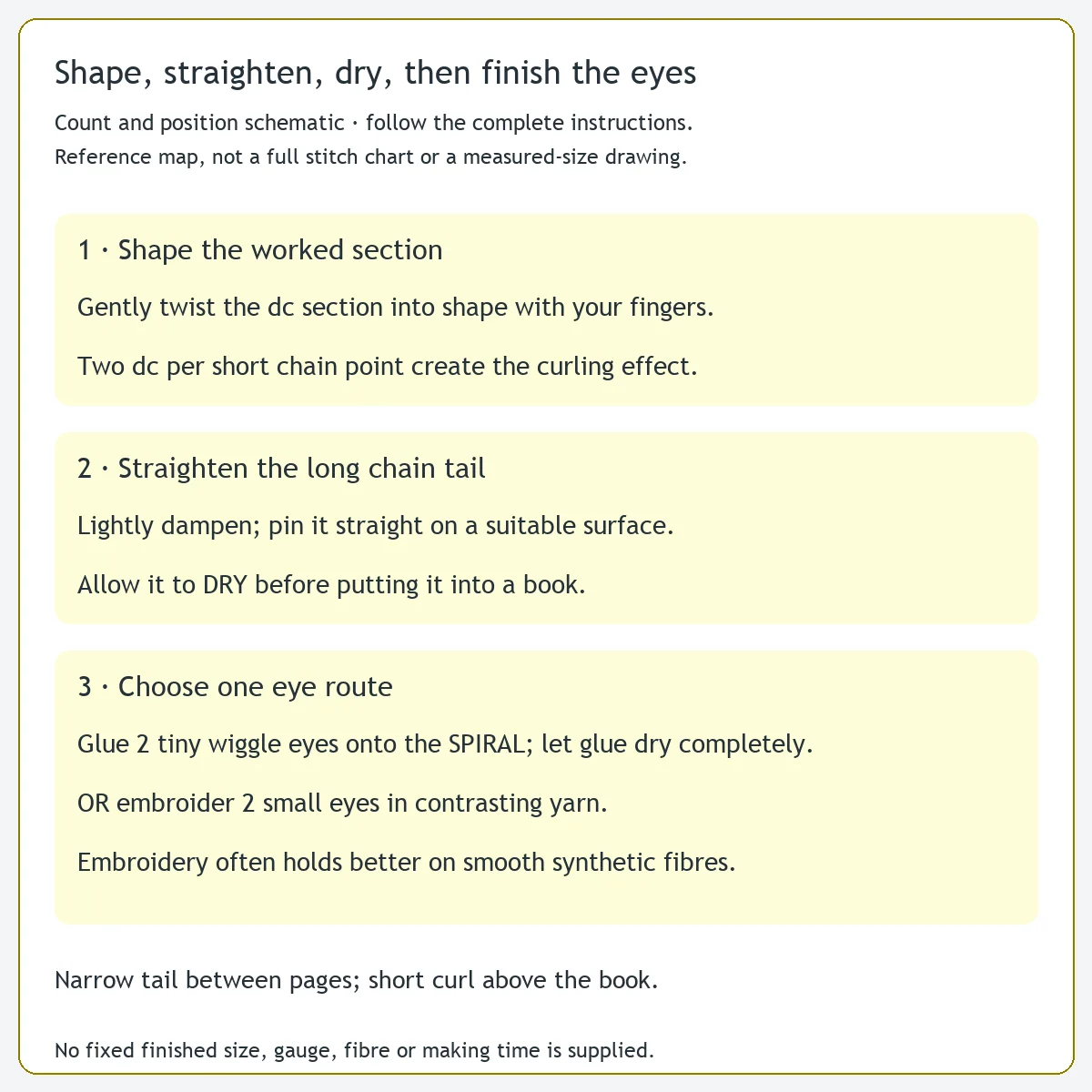
Gently twist the double crochet section into shape with your fingers. The doubled number of stitches along a short section of chain makes it curl by itself.
Straighten the tail and attach the eyes
Lightly dampen the long chain tail and pin it straight on a suitable surface. Allow it to dry before putting the bookmark into a book. Glue the wiggle eyes to the spiral section and let the glue dry completely. Embroidered eyes often hold better on smooth synthetic fibres.
Organise the bookmark into clear making stages
Prepare one scrap and keep the count with it
A solid bright lemon yellow is an optional project colour here, not a source requirement. Choose a fine scrap that works with the stated small-hook reference, rather than assuming a thicker leftover will produce the same bookmark dimensions. The approximately 1.2 m is a source estimate, not a guarantee of exact consumption for every yarn. Check the available scrap and leave enough end to secure it. Scissors and the yarn needle should be within reach before the short stitched section is cut from the working supply.
Choose the eye option before the finishing stage: two tiny wiggle eyes with craft glue, or two small embroidered eyes in contrasting yarn. Keep the chosen materials with the project so that “crochet finished” is not confused with “bookmark ready for the book.” The source does not name a fibre, gram quantity, gauge, numerical millimetre hook or working time. Do not fill those gaps with remembered details from another worm pattern. A small project can still need its own actual yarn note and a check of how the tail behaves when laid flat.
Use the first pause to verify seventy completed chains
Count completed chain links below the active loop. The loop on the hook is excluded from seventy. If it helps, divide the count into temporary sections that can be checked separately, then remove any markers that would obscure the working end. After the chain is turned, count back from the hook to identify the third completed chain. The first pair belongs there. Inserting into the active loop or the second chain would change the source’s route even if you later managed to make twenty-six dc somewhere along the chain.
Write the foundation count and next action on a small working note if the project is paused at this point. “Seventy chains, next pair in chain three” is more useful than “ready to curl.” Secure the live loop without pulling it smaller and keep the hook reference with the scrap if the hook is removed. The source’s turning instruction changes the working direction; it does not ask for a second seventy-chain foundation or a new set of decorative stitches along the whole tail.
Count thirteen positions separately from twenty-six stitches
Work each dc pair completely before moving to the next chain. The first insertion point is chain three from the hook; twelve further consecutive points follow it. Thirteen points receiving two dc each produce twenty-six dc. That is not an instruction to place pairs in twenty-six chains. A practical tally can mark one completed pair rather than one individual stitch. Keep the two counting systems separate so that a pause after, for example, a completed pair can be resumed at the next chain rather than halfway through an uncertain group.
The worked positions are chains 3 through 15 when counted from the hook end of the original chain. The immediately following chain is 16 and receives the finishing slip stitch. Do not put that slip stitch into the same chain as the final pair or skip another chain before joining. The remaining chains 17 through 70 form the fifty-four-link free tail. This allocation distinguishes the worked chain targets from the free tail; measure the actual dry length separately. Two initial skipped chains also belong to the foundation accounting, but not to the twenty-six worked dc.
Finish the crochet before treating the tail
After the slip stitch, cut the working yarn and weave its end into the double crochet section as instructed. Do not use a long loose strand across the tail as a substitute for secure weaving. Gently guide the stitched portion into its curl with your fingers. The source relies on doubled stitches over a short length of chain for the curling effect. It does not call for stuffing, a separate head, wire or a second crocheted piece. Adding those would create a different construction with its own material and handling decisions.
Check the stitch positions before trying to correct a curl by adding more dc. Twenty-six correctly placed stitches are the source target. A curl that looks different while held in the hand does not by itself prove a missing pair. Put the piece down, compare the thirteen pair locations and identify the slip-stitch boundary. The actual curl and measured dimensions of your chosen yarn still have to be observed on the bookmark you make.
Allow a separate stage for straightening and drying
The source lightly dampens the long chain and pins it straight on a suitable surface. Keep the chain supported and arrange the tail without stretching it to an arbitrary ruler mark. No finished measurement is specified. Allow it to dry before it touches a book. That instruction is a material-handling stage rather than a promised number of minutes. A note saying the tail is still drying prevents a later session from treating the project as ready simply because the crochet portion has already been fastened off.
Attach the two wiggle eyes to the spiral section if using the glued option and allow the glue to dry completely. The source notes that embroidered eyes often hold better on smooth synthetic fibres. Keep the embroidered alternative as a complete choice instead of assuming both methods must be used together. No drying duration, glue brand or precise eye spacing is supplied. Record personal finishing choices separately and do not present them as fixed measurements from the source.
Check the bookmark’s role before putting it away
The narrow tail is the section intended to sit between pages, while the short curl remains above the book. Inspect the actual completed piece and make sure no end is loose before use. This is a bookmark-specific construction, not a long fully worked decorative worm. The free tail and the position of the curl are the reasons to preserve the source sequence. If planning another copy, keep the original seventy-chain and thirteen-point note rather than assuming a remembered worm recipe will produce the same division of material.
Compare another small crochet project
The freestanding spiral worm has its own construction and material choices. It is a useful explicit comparison, but its worked body should not replace this bookmark’s fifty-four-chain free tail. The Twinkling square sessions offer another small project with different anchors and rounds. Browse the pattern collection for a next project and the author page for editorial context. Keep each complete pattern with its own counts, even when both projects use a familiar curling stitch effect.