
 Ruby Ellis
This textured scarf alternates a low single crochet with a taller double crochet. After turning, the next row places the low stitch over a tall one and the tall stitch over a low one. The repeat is small enough to memorise, but its edges still deserve attention. A useful session begins by locating the first actual stitch, works complete pairs across the row and ends by checking the final double crochet. Twenty worked stitches stay twenty as the scarf grows; the length changes through repeated rows, not through extra edge stitches.
A repeat that fits short making sessions
For a short period of making, stop after a whole row whenever possible. Note the completed length rather than setting an arbitrary row target from another yarn. The source gives several suggested lengths but no fixed row totals for them. If you pause mid-row, leave the active loop secure and write down the next stitch type. The top of the previous row can also guide you: the next single crochet belongs in a double crochet, and the next double crochet belongs in a single crochet. This position-based reminder remains useful after a longer interruption.
Prepare yarn and separate example quantities from goals
Use the category-four worsted and six-and-a-half-millimetre hook listed below. A possible solid-colour choice is hot magenta; the structure also works when a chosen yarn changes colour along its length. Keep scissors and the yarn needle with the work so that each joining end can be dealt with deliberately. Save the yarn label for its care information and for later matching. The approximate one-hundred-and-fifty-gram example is associated with a scarf of about one hundred and fifty-two centimetres. It does not separately specify the amount for each of the three suggested target lengths.
Begin the twenty-stitch width and work enough rows to handle the fabric as a small piece. Let it rest, measure its actual width and fold it between your fingers. The dense-looking texture should still bend comfortably around the neck. This early section can become the beginning of the scarf if its width and feel suit you. If a different width is needed, retain an even number of worked stitches so that the alternating pair ends with a double crochet. Decide this at the beginning rather than narrowing or widening the scarf accidentally as you continue.
Make the foundation easy to check
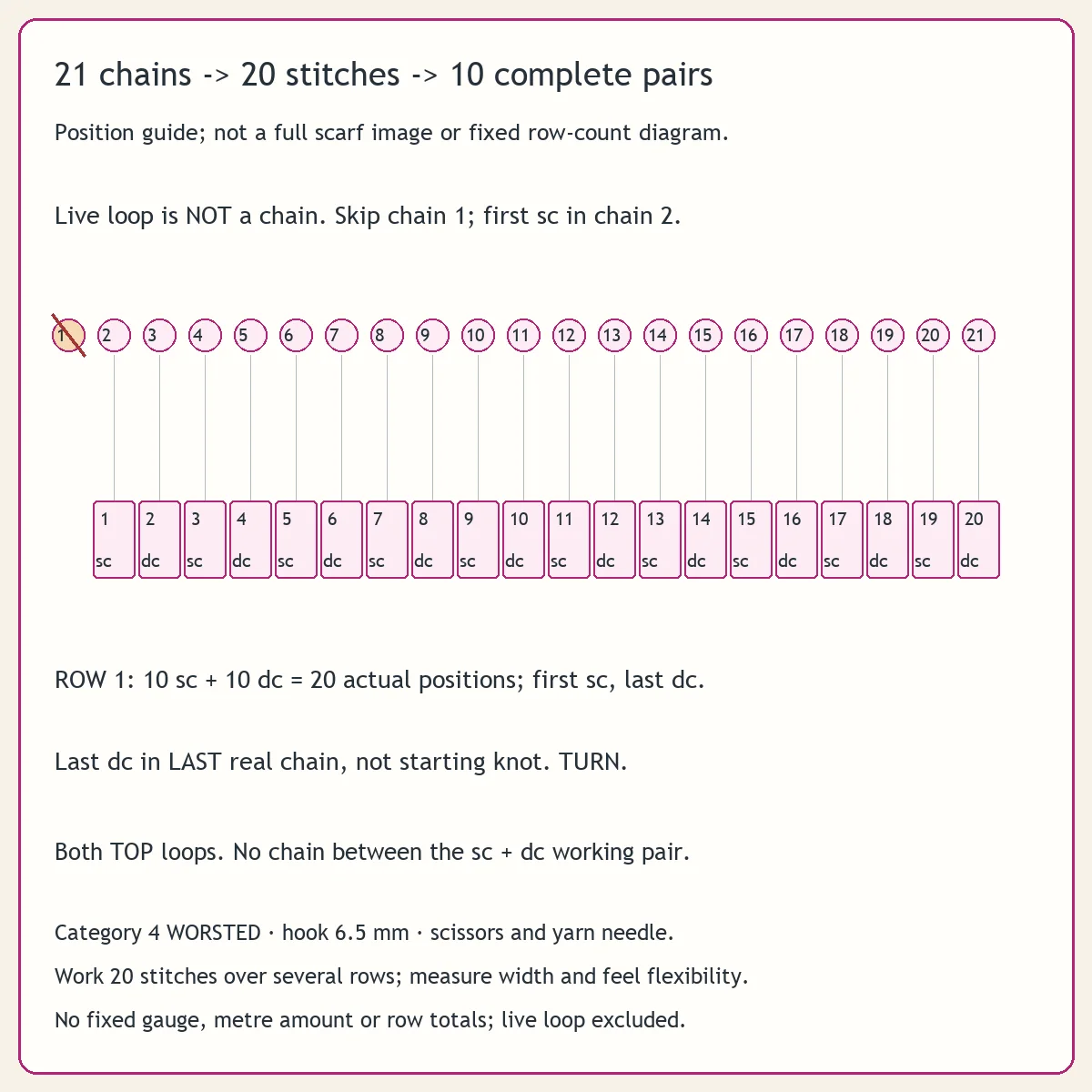
The starting chain contains twenty-one chains, while the first worked row contains twenty stitches. The skipped chain beside the hook is not an extra pattern position. Work into the second chain, then alternate the two stitch types through the last real chain. There are ten complete pairs. A quick pause at a finished pair makes counting easier than stopping between its low and high stitches. Keep the starting knot distinct from a chain link at the far end so that it does not receive an unintended extra stitch.
The first row can look uneven along its top because its stitch heights alternate. That is different from an overly tight foundation pulling the lower edge inward. Let the chain remain flexible and examine the small fabric after several rows, when the compensating heights are easier to see. Mark the actual first single crochet and final double crochet if the ends are difficult to find. After turning, their places on the table reverse, but they remain real edge stitches. The turning chain has another job and does not receive its own counted pattern position.
Return to the same twenty positions
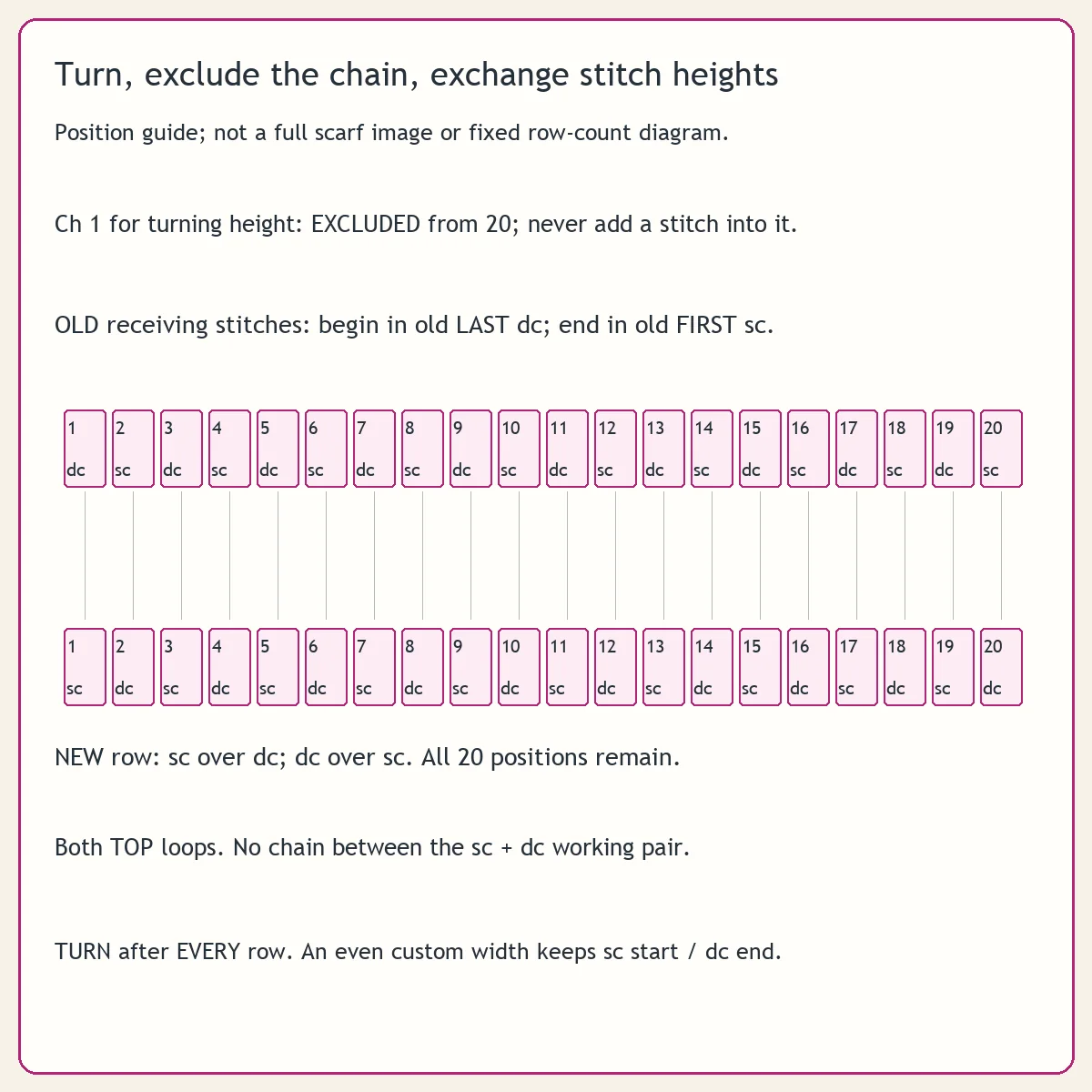
Each later row begins with one turning chain, then a single crochet in the first double crochet of the previous row. No chain separates the working single crochet and double crochet. Continue into consecutive stitch tops through both upper loops. At the far edge, the final double crochet belongs in the previous row's first single crochet. Working an additional stitch into its turning chain would enlarge the width. Skipping that first single crochet instead would reduce it. Compare both edge positions before trying to correct a change merely by pulling the fabric straighter.
If you reach the end expecting a single crochet, stop and count before adding anything. An even run beginning with single crochet should finish with double crochet. Look for an omitted position or two neighbouring stitches of the wrong type. Returning over the most recent pair is easier while it is still visible than after several more rows. When a new ball is required, change at a row end where possible, keep the same pair sequence and note the joining ends for later weaving. A colour transition does not call for an extra stitch, chain or shortened row.
Choose a stopping point from relaxed length
Lay the scarf down without pulling and measure along a long edge. The suggested short, medium and long lengths are choices of stopping point at the same width. They do not introduce different shaping rows. Compare the selected length with how you intend to wear the scarf, and allow your yarn supply to match that choice. Measuring at the same relaxed state during later sessions is more useful than stretching the work to reach a number sooner. Keep the row complete before ending so that both short edges contain the same number of pattern positions.
After pulling the cut end through the last loop, secure it loosely at first and lay the scarf flat to compare both long edges. Then weave each beginning and ending tail separately through several stitch bodies on the reverse, change direction and avoid drawing a small pucker into the fabric. The source construction finishes with its existing edges. Optional blocking follows the yarn care information and keeps the grainy texture from being pressed flat. If the scarf is washed, wait until it is dry before recording its final length. These checkpoints make the next scarf easier to repeat with the same materials.
Yarn, hook and the two working stitches
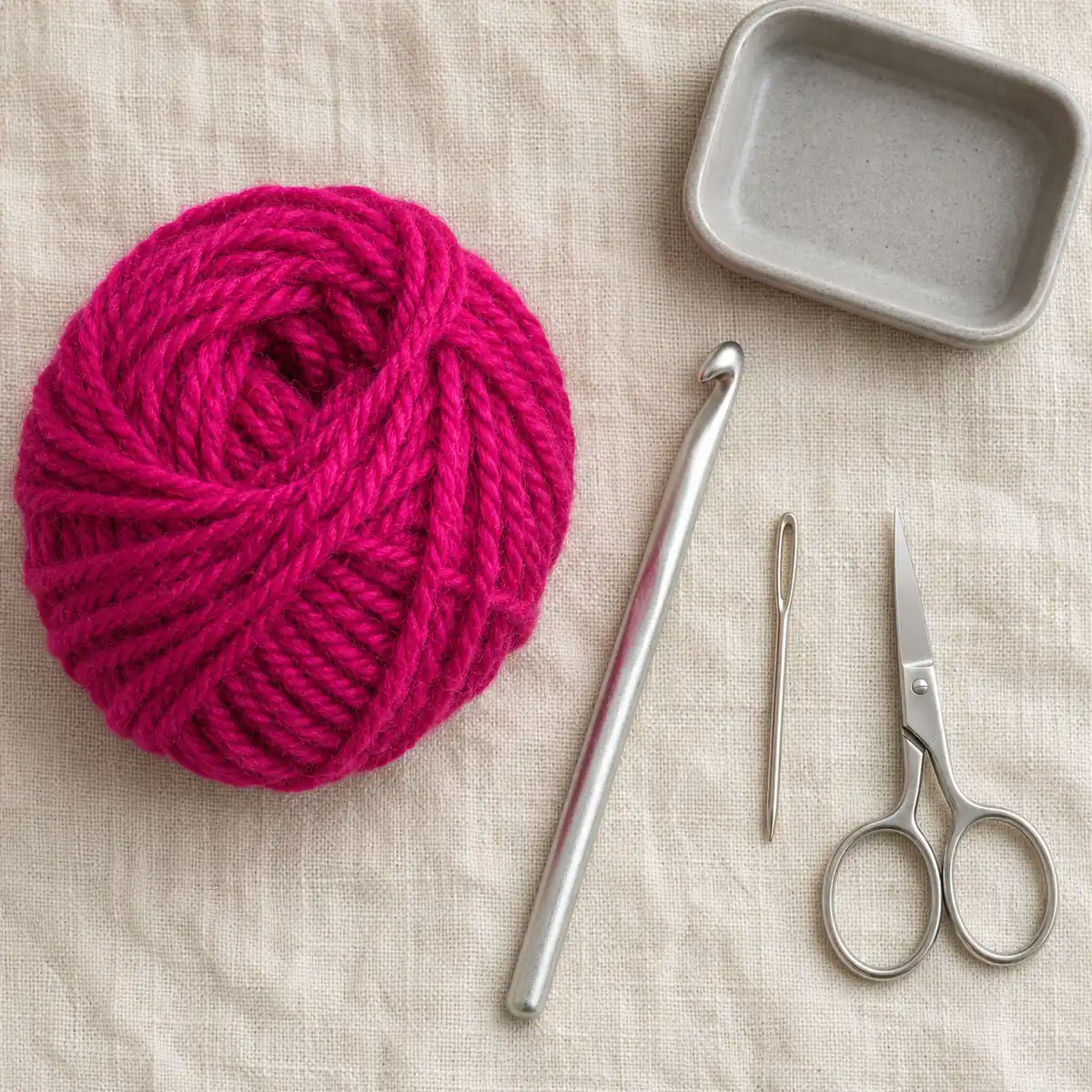
Use category 4 worsted yarn and a 6.5 mm crochet hook, with scissors and a yarn needle. The source gives approximately 150 g for an approximately 152 cm example. It provides neither a definite metre requirement nor a binding gauge. Make the twenty-stitch width over several rows, measure its actual width and feel whether it folds comfortably. A different width needs an even number of worked stitches so that each row begins with single crochet and ends with double crochet.
These instructions use US terms: ch is chain, sl st slip stitch, sc single crochet, hdc half double crochet and dc double crochet. The loop on the hook does not count as a stitch. Work through both top loops unless stated otherwise. For sc, insert the hook, draw up a loop, yarn over and pull through both loops. For dc, yarn over before inserting, draw up a loop, then yarn over and pull through two loops twice. The alternating low and high stitches exchange roles in the following row.
Foundation and first row
Twenty worked stitches from twenty-one chains
Chain 21. Work 1 sc in the second chain from the hook, then 1 dc in the following chain. Continue alternating sc and dc to the end: 20 stitches, beginning with sc and ending with dc. Turn. The first chain is left unworked, and the starting knot is not an extra chain. The first pair followed by nine more pairs makes ten sc and ten dc. Keep the chain loose enough for a flexible lower edge. Mark the actual first sc and last dc, not a turning chain.
Repeat the second row to the selected length
Chain 1. Work 1 sc into the first dc of the previous row, then 1 dc into the next sc. Repeat this pair over all 20 stitches, beginning with sc and ending with dc. Turn. Repeat this row continuously. The turning chain is not one of the twenty pattern positions, and no chain goes between the two working stitches. The last dc goes into the previous row’s first sc, never additionally into its turning chain.
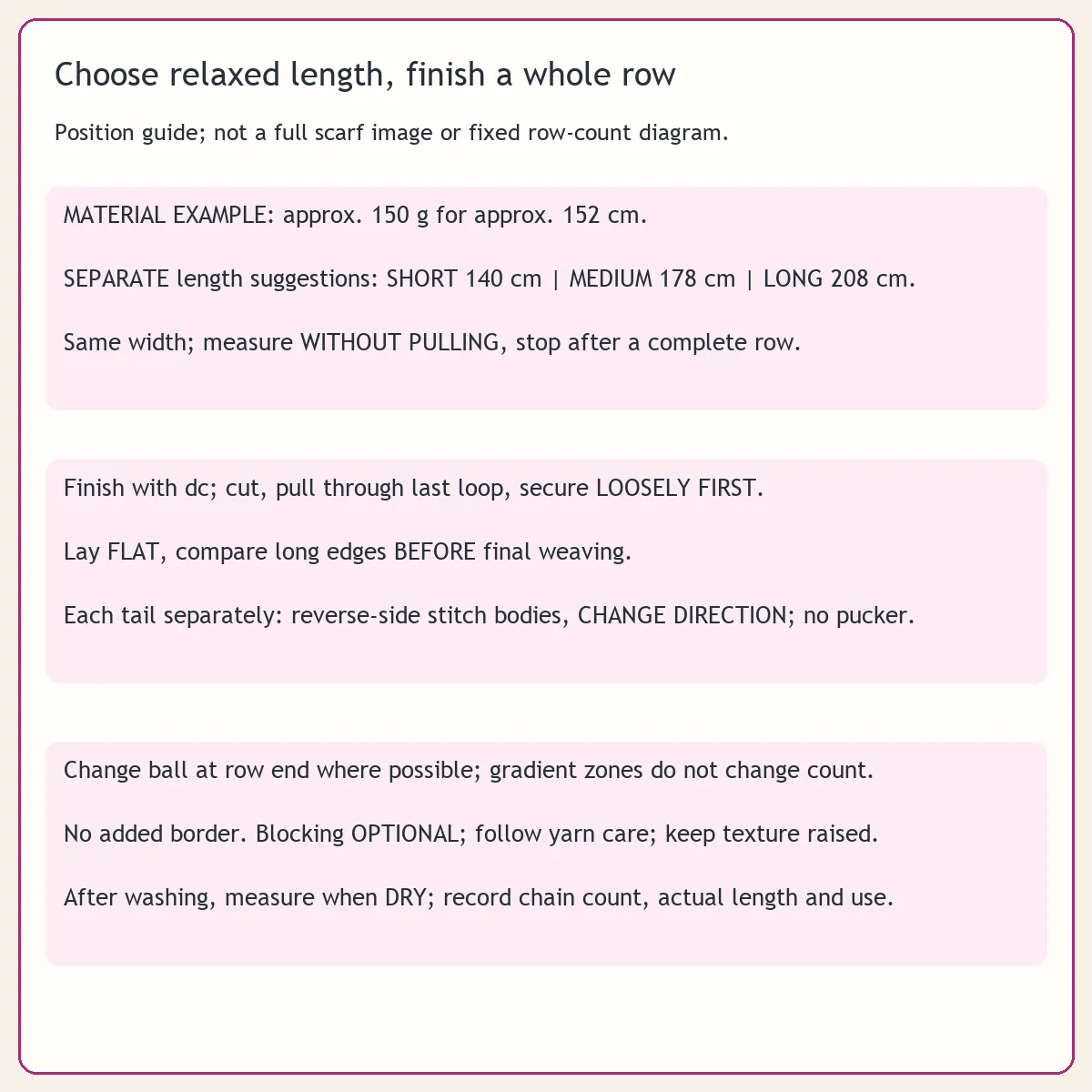
Suggested lengths are approximately 140 cm for short, 178 cm for medium and 208 cm for long, all at the same width. Measure the resting scarf without pulling; length rather than a fixed row total controls the stop. Keep checking twenty stitches and the last edge position. Gradient colour zones do not change this count. When another ball is needed, change at a row end where possible, continue the same pair and allow enough yarn for the selected total length.
Finish a whole row and secure the ends
Finish after a complete row, with dc as its final stitch. Cut the yarn, pull it through the last loop and secure it loosely at first. Lay the scarf flat and compare its long edges before final weaving. Weave each joining and ending tail separately through several stitch bodies on the reverse, then change direction to secure it; do not draw the fabric into a pucker. There is no additional border round in the source construction. Align the edges gently with your fingers. Blocking is optional: follow the yarn’s care instructions and avoid pressing the textured surface flat. If washed, measure again only after drying. Note the foundation count, actual length and used yarn amount for a later scarf.
Questions between rows
Why does the first stitch type stay the same after turning? The old row ends with double crochet, so that stitch becomes the first receiving position for the next row's single crochet. Why is the turning chain excluded? It raises the start; it is not another one of the twenty positions. What if a gradient colour band ends halfway across? Continue the pair without changing width. Why count the final stitch after a yarn change? The colour can distract from the edge, while the low-high rule remains the same. The related scarf patterns below offer other textures to compare by their own measured fabric.
Related scarf textures
Compare the half-double-crochet scarf · Explore the linen-stitch cowl · More patterns · About the author