
 Ruby Ellis
This textured blanket repeats a small group of three different-height stitches, all placed in one destination. Once the first row is established, the same return row builds the fabric to the chosen length. A practical making session therefore needs two records: the selected foundation size and the number of groups across a completed row. This guide keeps those checks beside the complete instructions. The six source options range from a comfort square to a single-bed blanket. Their listed widths describe the relaxed starting chain, not a guaranteed finished blanket width; sample the actual fabric before committing to a particular result.
Materials and six sizes · Foundation and repeat · Border · Session preparation
Choose the yarn and blanket size
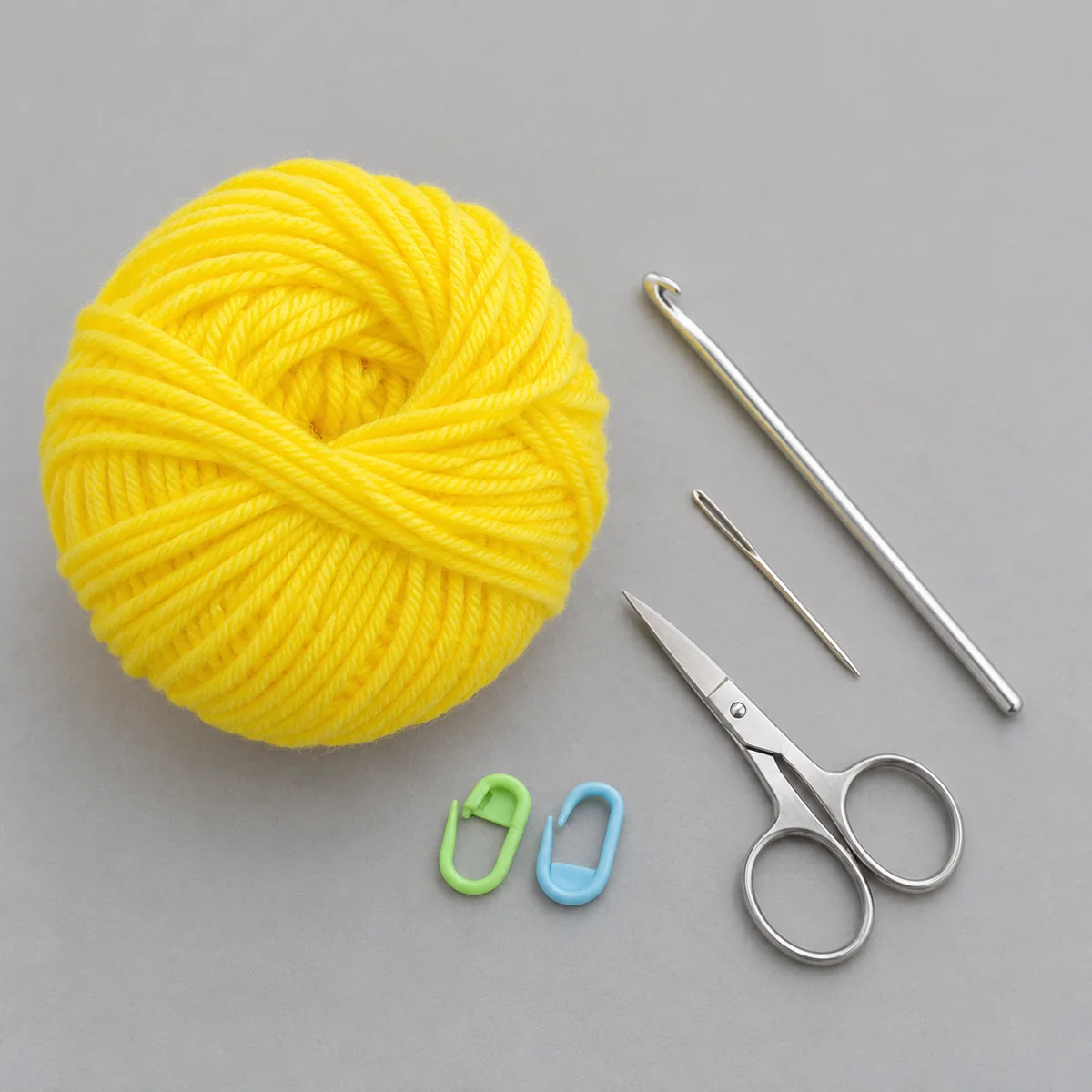
You need worsted yarn, category 4, a 5.5 mm crochet hook, scissors and a yarn needle. This pattern uses US crochet terminology: ch means chain, sc means single crochet, hdc means half double crochet, dc means double crochet and sl st means slip stitch. The repeated group contains one sc, one hdc and one dc, all worked in the same insertion point. The different heights create the textured surface.
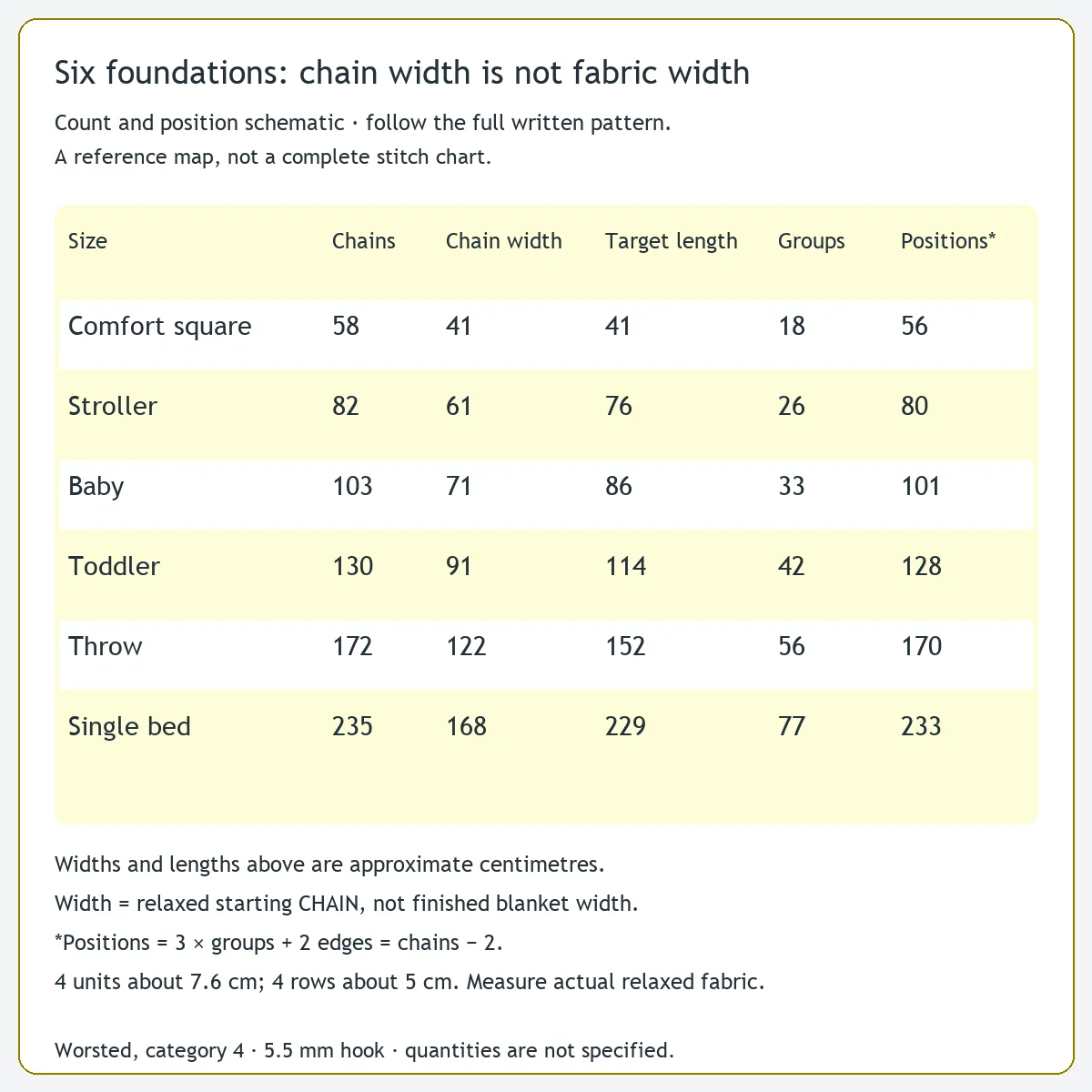
| Size | Foundation chains | Chain width × target length, approximately |
|---|---|---|
| Comfort square | 58 | 41 × 41 cm |
| Stroller blanket | 82 | 61 × 76 cm |
| Baby blanket | 103 | 71 × 86 cm |
| Toddler blanket | 130 | 91 × 114 cm |
| Throw | 172 | 122 × 152 cm |
| Single-bed blanket | 235 | 168 × 229 cm |
The width refers to the loosely laid-out foundation chain. The fabric may widen a little after several rows. For another width, make a multiple of 3 plus 1 chain. The source states that 4 pattern units are approximately 7.6 cm wide and 4 rows are approximately 5 cm high. If dimensions matter, crochet a sample first and measure it without stretching.
Work the first pattern row
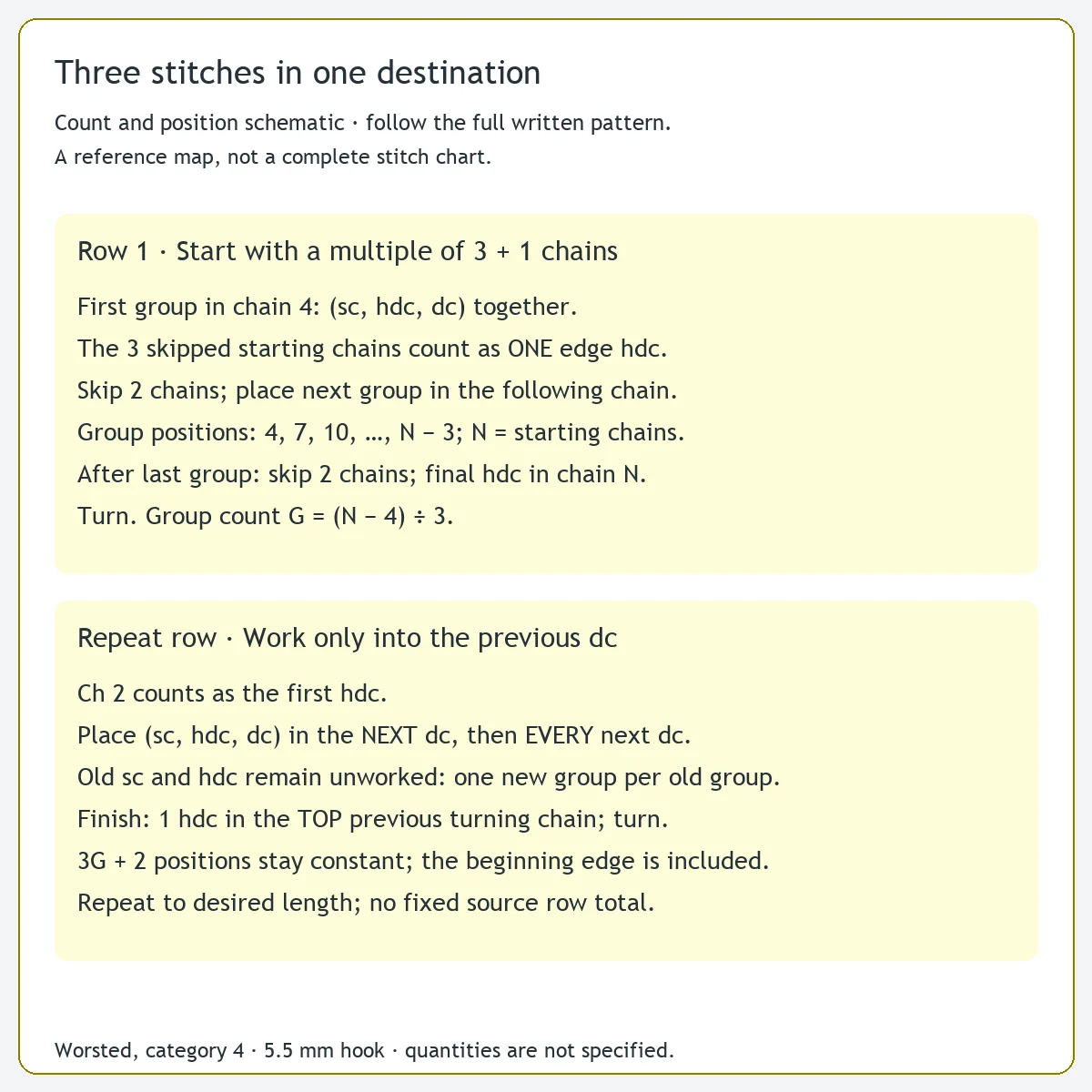
Loosely chain the number specified for your selected size. With the right side facing, work 1 sc, 1 hdc and 1 dc into the fourth chain from the hook. The 3 skipped beginning chains count together as 1 hdc. Skip 2 chains and work the next three-stitch group into the following chain. Repeat this across. After the final group, leave the next two chains unworked and work 1 hdc into the last chain. Turn.
With 103 foundation chains, you obtain 33 three-stitch groups and 1 hdc at each edge. The groups sit in the fourth, seventh, tenth and every following third chain up to the hundredth. Use this to check the foundation before beginning the second row.
Repeat the textured row
Ch 2 to count as the first hdc. Work 1 sc, 1 hdc and 1 dc together into the next dc, then into every following dc of the previous row. Leave the other two stitches of each group unworked. Finish the row with 1 hdc into the top turning chain of the previous row and turn.
Repeat this second row until the desired length is reached. Occasionally check the number of groups. If the edge becomes narrower, first check whether the finishing hdc has been omitted.
Add the single crochet border
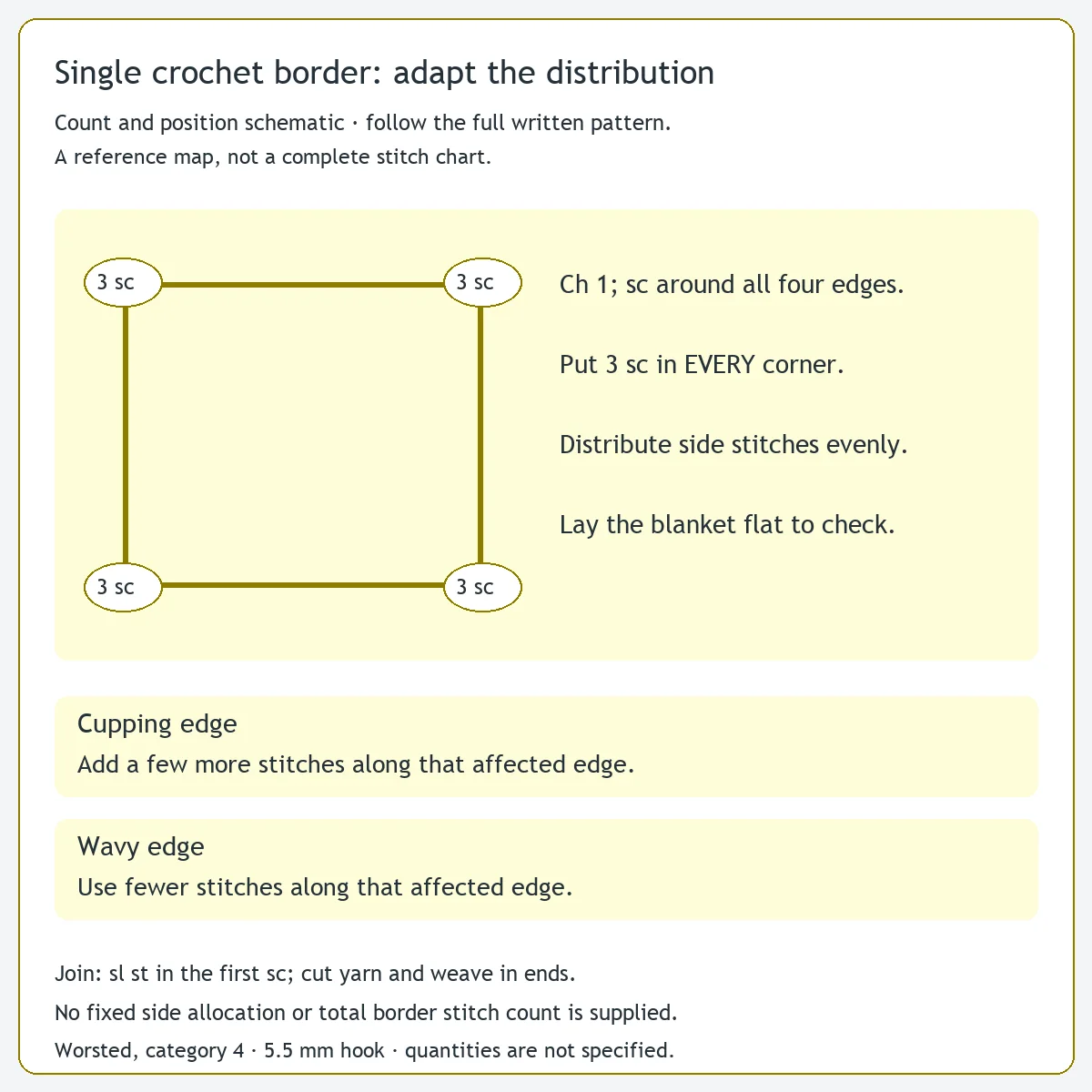
Ch 1 and work sc around the entire blanket. Work 3 sc into every corner and distribute the stitches evenly along the 4 edges. Lay the blanket flat occasionally. If the edge cups, distribute a few more stitches along the affected edge. If the edge becomes wavy, work fewer stitches there. Close the round with 1 sl st in the first sc, cut the yarn and weave in the ends.
Prepare one size before starting a batch of rows
Keep the source chain width separate from fabric width
Choose one table row and copy its foundation count and target length onto the working note. Write “chain width” beside its first measurement. The source’s width is measured from a loosely laid-out chain, before the grouped texture exists. The later fabric may widen. The stated unit gauge is another reference: four units are approximately 7.6 cm wide, while four rows are approximately 5 cm high. Those approximate figures do not establish that every chain-width label predicts an identical finished width. Do not silently change the foundation to make the two references appear to agree.
Make and measure a sample when dimensions matter. Let it relax and record the chosen yarn and the specified 5.5 mm hook alongside the result. The source calls for worsted, category 4, but does not name a fibre, brand, gram weight, metre quantity or making time. A solid bright lemon yellow is an optional project colour here, not a required source shade. Keep any material substitution clearly labelled. Neither the hook size nor the size name supplies enough information to calculate a truthful quantity for a complete blanket without additional evidence.
Use the first session to confirm the foundation route
Every listed foundation is a multiple of three plus one. The available chain counts are 58, 82, 103, 130, 172 and 235. Their corresponding group counts are 18, 26, 33, 42, 56 and 77. Put the chosen pair on the same line of your note. Checking that pair before the second row prevents an accidental mix of the small foundation and a larger group target. Temporary chain markers can divide a long count into sections, but remove them when their purpose has ended rather than letting them obscure the working edge.
The first group goes into chain 4 from the hook. Each next group advances three chain positions because two are skipped before the following insertion. The last group is in chain N minus 3, where N is the full foundation count. Two chains then remain unworked before the final hdc in chain N. The three skipped chains at the beginning count together as the opposite edge hdc. This starting chain convention is part of the first row and should not be replaced by the repeat row’s two-chain start.
Count a complete group rather than three separate destinations
A group contains sc, hdc and dc in the same insertion point. These are three produced stitch posts from one destination; they are not spread across three adjacent foundation chains. At the end of a completed row, the groups plus the two edge positions give 3G + 2 positions, where G is the group count. For the six source foundations, the totals are 56, 80, 101, 128, 170 and 233, respectively. These equal N minus 2. The represented beginning edge is included rather than added again.
For the 103-chain version, the thirty-three groups sit in chains 4, 7, 10 and so on through chain 100. The final hdc belongs in chain 103, leaving chains 101 and 102 unworked between it and the final group. This example is a useful check before returning across the foundation. If the number of groups is right but the last hdc has no destination, recount the starting chain and the first group position. Adding an improvised group at the end would hide the foundation error rather than preserve the selected size.
Resume at the next dc, not at every visible stitch
The repeat row begins with ch 2 counted as the first hdc. Its groups go into the next dc and then each following dc of the preceding row. The other two stitches in every old group remain unworked. This selection is what keeps one new group corresponding to one old group. Working a group into every visible stitch would multiply the width. When resuming a session, identify the tall dc destination before starting a new group, particularly if the texture makes neighbouring stitch tops difficult to distinguish.
The far edge still needs its finishing hdc in the top turning chain of the previous row. In the first return, that previous beginning edge comes from the three skipped foundation chains; later returns reach the two-chain beginnings of repeat rows. Preserve the written destinations without standardising the two chain heights. Turn after every row and add to a tally only when the row is complete. The source does not give a fixed row total for any size. Stop according to the desired measured length, rather than inventing a mandatory count from an approximate height gauge.
Separate body sessions from the adaptive border
Keep a body-length measurement with its conditions instead of treating a row tally as a measurement by itself. If the fabric is being lifted or stretched, put it down before checking. When the body reaches the desired length, read the whole border instruction before adding its first chain. The border uses sc around all four edges and three sc at each corner. It does not provide a fixed number for an entire side or for the whole round, so an exact border total cannot be inferred from the number of textured groups alone.
Lay the border flat at intervals. If it cups, the source asks for a few more stitches along the affected edge; if it becomes wavy, use fewer there. Check the affected section rather than making an unrelated change to every side. The three-sc corner rule stays intact. This is an adaptive distribution around real edges, including row ends, not a new fixed repeat with a promised total. Finish with the stated slip-stitch join, cut the yarn and weave in the ends. Follow the yarn’s care guidance for any later treatment.
Leave a clear next action when putting the blanket away
Record the chosen foundation, its group target, the last completed row and whether the next action is turning or starting the counted chain. If you stop mid-row, state that separately and secure the live loop. For a border pause, name the edge currently being worked and any distribution adjustment already made. Your sample and finished measurements remain the evidence for actual fabric size, drape and material use.
Compare another blanket workflow
The gradient double crochet blanket sessions use a constant-width row with individual dc rather than mixed-height groups. Its own turning-chain and material rules stay with that pattern. The eyelet stripe square workflow offers a smaller project with alternating open and dense rounds. Find further projects in the pattern collection and editorial information on the author page. Choose the next project by the work you want to practise, while keeping this blanket’s size note and unfinished edge decisions together.