
 Ruby Ellis
This dango pendant is made from three separate crocheted balls mounted on one wooden skewer. Each ball follows the same fourteen rounds without a colour change inside it. The finished stack has its own colour order, while the making order can be tracked one component at a time. A practical session list gives each colour a column, with every round marked separately. That keeps one piece from losing a plain middle round simply because the next yarn is already waiting. Matching construction matters as much as a matching final count.
Three small balls, three clear progress columns
The source uses pink above white above green. All three balls have the same expansion, six unchanged thirty-stitch rounds and three reductions to a twelve-stitch opening. That opening remains for the assembly stage; a familiar extra decrease to six is not part of this sequence. Read the filling and mounting instructions before trimming any end. The long tails later connect the contact areas between balls, so a completed crochet round does not mean that every remaining thread is ready to hide. Keep those yarn roles visible while storing unfinished components.
Prepare comparable yarns and an explicit colour key
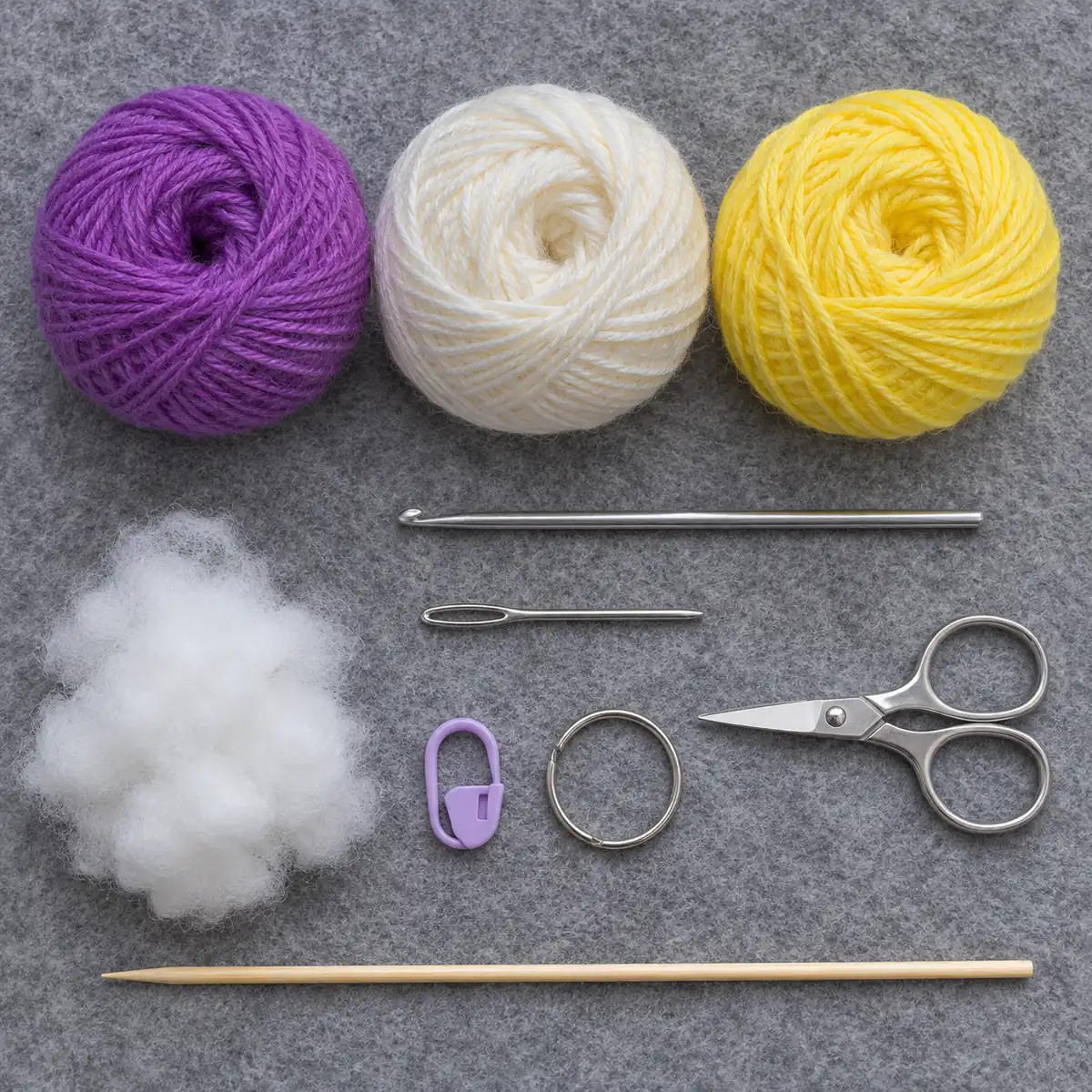
Use the source's two-millimetre hook with yarns of comparable thickness, plus needle, scissors, stuffing and wooden skewer. A keyring is optional. One colour variation maps pink to violet, white to ivory white and green to lemon yellow. The original names remain in the full instructions below. The role order stays clear: violet at the top, ivory in the middle and lemon at the bottom for that optional version. Save a short labelled sample of each yarn if similar shades may be mixed in the project bag.
The source writes the total height as seven slash nine centimetres, interpreted as approximately seven to nine for the whole pendant. It is not a separate size target for each ball. There is no fixed yarn category or gram amount, and the skewer's visible lower length is left open. Save actual yarn information and measure the assembled result for a matching second pendant. The first ball also offers a small material comparison before continuing: if another colour is much thicker, the same round count can produce a different size. Choose matching yarn behaviour rather than compensating with an unlisted stitch sequence.
Give six plain rounds six separate marks
The expansion reaches thirty stitches after round five. The next six rounds maintain that count and build the middle's height. Mark rounds six, seven, eight, nine, ten and eleven individually. The two boundary numbers do not mean only two plain rounds. A small cup after the increases is not yet the completed ball body. Follow the whole stated sequence before narrowing, even if the early piece already looks round from one angle. The two later colours need the same middle section to match it.
Work continuously and choose either a first-stitch or last-stitch marker, then keep that choice for all three pieces. Do not add a slip stitch and chain at every apparent transition. A continuous round may meet the previous one at a slight angle; the count and marker locate the next route. Count completed stitches rather than two separate top loops. After a pause, find the marker, check the last completed round and continue the same method. A three-column record can show forty-two rounds in all without turning them into one long colour-changing body.
Reduce, leave the opening and fill during assembly
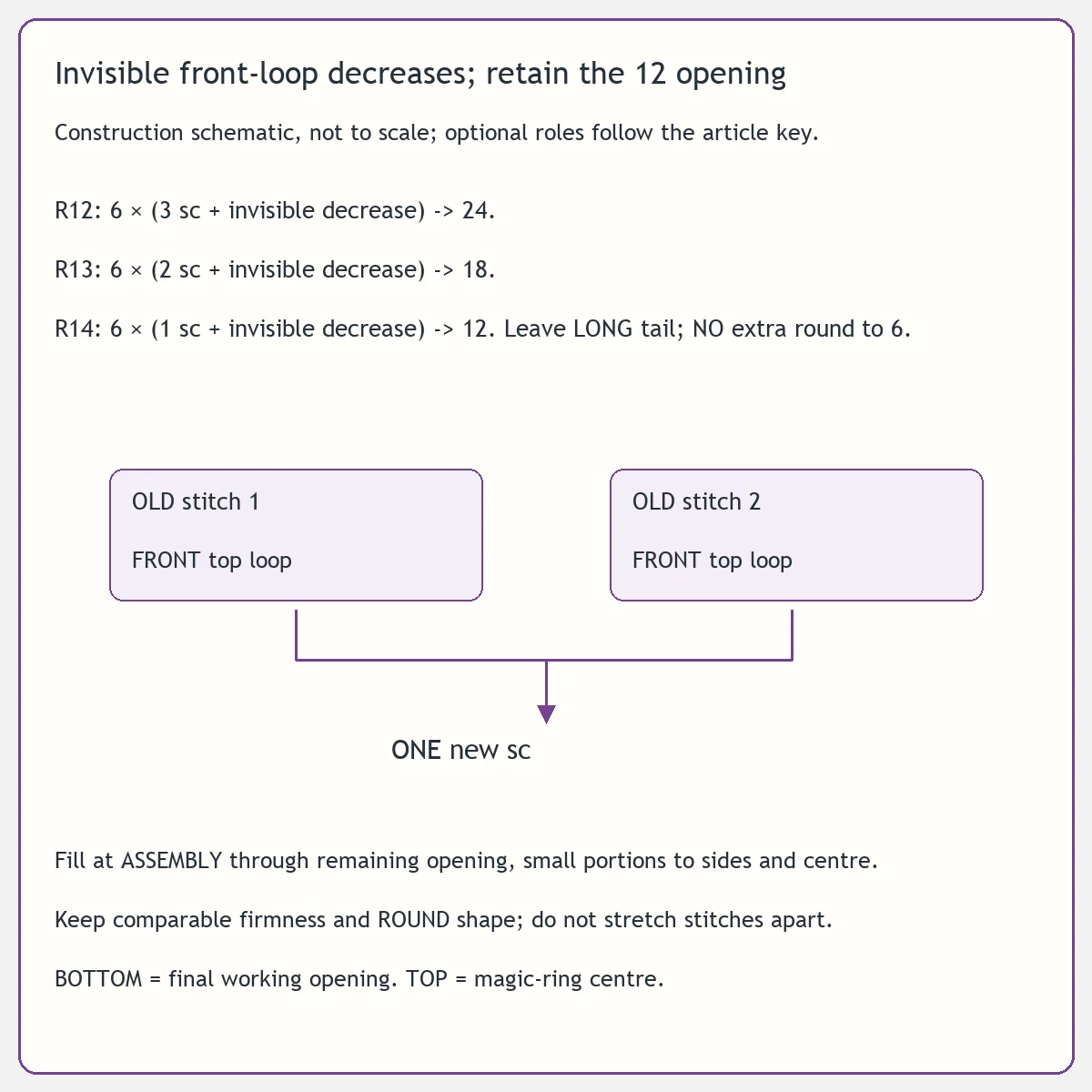
The final three rounds bring thirty to twenty-four, eighteen and twelve. The source's invisible decrease uses the front top loops of two neighbouring stitches to make one single crochet. Its inside remains inside the ball. Check a complete repeat if the round does not fit rather than adding an isolated extra decrease at the end. At twelve, retain the long sewing end and leave the working opening for the next stage. This is the point to put that colour's crochet column into a finished state, separate from its still-pending filling and assembly.
Fill with small portions through the available opening during assembly. Move filling toward the sides as well as the centre without stretching the fabric. Compare the three shapes for similar firmness and roundness rather than packing one hard and leaving the others soft. Locate the magic-ring centre at the top and the final opening opposite it below. A marker or tail can preserve that orientation. The balls need not be flattened to find their centres. Keeping the two areas visible prepares the skewer route without pulling long side loops out of the crochet.
Mount and secure before adding the optional ring
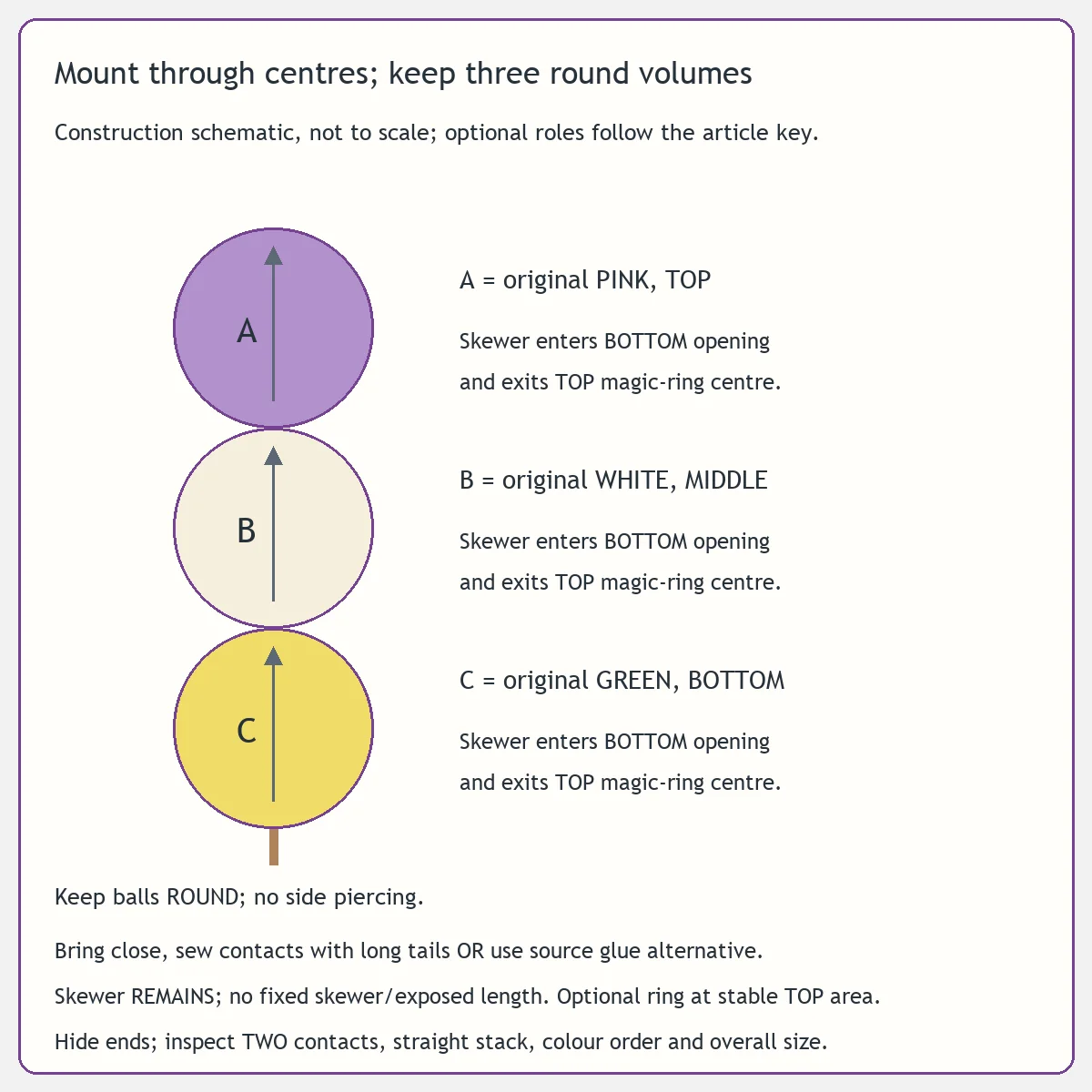
Guide the skewer into each filled ball from the bottom and out through the top magic-ring centre. Follow those existing central areas, hold the piece round and examine the straight route after each addition. Arrange green below white below pink, or the corresponding optional colour roles. Bring the balls close together before tightening their sewing threads so that the contact is secure without crushing the three separate round volumes. The skewer remains as their common middle support, not merely a temporary shaping tool.
Use the long ends for several small stitches through stable areas on both sides of each contact, then hide them inside. The source also permits glue instead of sewing, with no specified product; it is an alternative method rather than a required extra step after stitching. If using the optional keyring, attach it at a stable area of the top ball, not an isolated pulled strand. Check alignment, every contact and visible end before measuring the complete pendant. The related small gifts below use other constructions, so follow their own assembly routes rather than transferring this three-ball stack to a different shape.
Three colours, one ball construction and a wooden skewer
Use pink, white and green yarn of comparable thickness, a 2 mm crochet hook, scissors, yarn needle, a wooden skewer and stuffing. A keyring is optional. The source writes the overall height as “7/9 cm”, understood here as approximately 7 to 9 cm for the complete pendant, not for each ball. Actual height depends on yarn and tension. No yarn category, gram amount or gauge is given, and no fixed skewer length or exposed lower length is specified.
Use US single crochet, abbreviated sc. An increase works two sc in one old position. A decrease joins two neighbouring old stitches into one new sc. For the source’s invisible decrease, catch the FRONT top loops of both neighbouring stitches and work them together into one sc, keeping the inside of the ball inward. Work continuously without a joining sl st or new chain at each round. Mark either the first or last stitch and keep the same method for all three pieces. The loop on the hook is not an extra stitch.
Make three separate balls through fourteen rounds each
The complete ball sequence
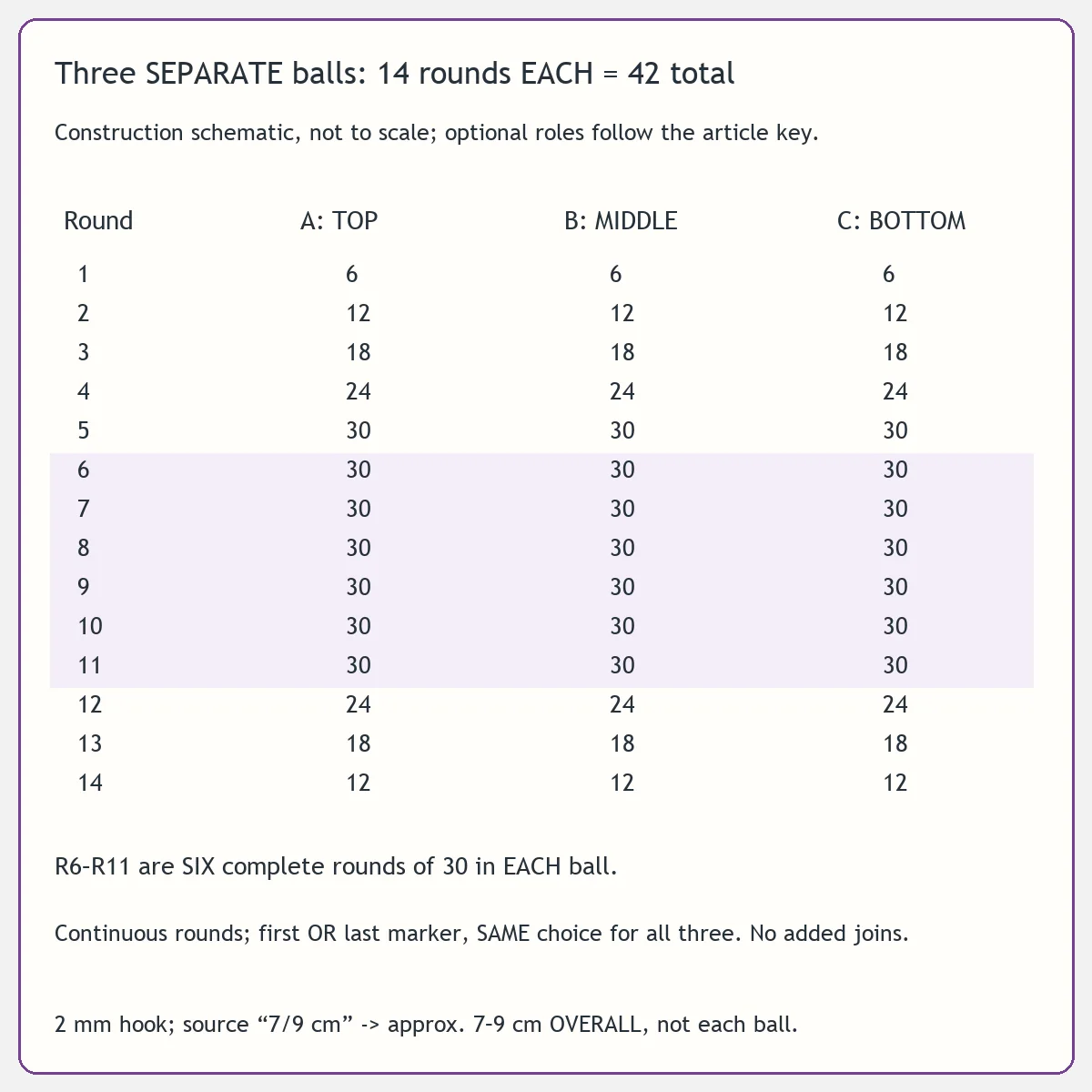
Round 1: 6 sc in a magic ring; close the ring: 6 stitches. Round 2: increase in every stitch, six increases: 12. Round 3: repeat 1 sc and 1 increase six times: 18. Round 4: repeat 2 sc and 1 increase six times: 24. Round 5: repeat 3 sc and 1 increase six times: 30. Rounds 6–11: work SIX complete rounds of 30 sc each, one sc per stitch.
Round 12: repeat 3 sc and 1 invisible decrease six times: 24. Round 13: repeat 2 sc and 1 invisible decrease six times: 18. Round 14: repeat 1 sc and 1 invisible decrease six times: 12. Leave a LONG sewing end. Do not add another decrease round to six. The twelve-stitch working opening remains for the assembly stage. Work the complete fourteen-round sequence once in pink, once in white and once in green, without changing colours within a ball.
Each ball has six plain thirty-stitch rounds between its growth and reductions. Count them separately rather than treating the numbers six and eleven as only two rounds. Three complete pieces make forty-two rounds altogether. A three-column round record can keep their progress separate. Do not start reductions early because the piece already looks like a little cup. Compare yarn thickness and tension if one ball looks different; the source gives no altered stitch count for compensating a thicker colour.
Check the shaping and fill in the assembly stage
Each increase adds one stitch, and each invisible decrease removes one. The round-twelve group of three sc and one decrease consumes five old positions and produces four new stitches: six groups use thirty and create twenty-four. The following groups reduce twenty-four to eighteen and eighteen to twelve. If a round does not fit, check the last complete group rather than adding a spare decrease at the end.
Fill each piece with small portions through the opening during assembly, as the source describes. Distribute filling toward the sides as well as the centre without stretching the stitches apart. All three should look comparably round and firm, not one overfilled beside two softer pieces. Identify the magic-ring centre at the top and the final working opening opposite it at the bottom. Keep these orientations clear with a marker or reserved tail until mounting. The balls do not need flattening to find those centres.
Mount, join and optionally add the keyring
Start assembly with the filled pieces. Guide the wooden skewer into a ball from its BOTTOM and out through the centre of its TOP magic ring. Follow the existing central areas rather than forcing it through an arbitrary side stitch, which could draw a long loop outward. Hold the ball round and check the skewer’s straight route after each addition. The finished order is GREEN at the bottom, WHITE in the middle and PINK on top.
Bring the balls close together before tightening their sewing ends, while preserving each round outer form. Use the long ends to sew touching areas together with several small stitches through stable crochet on both sides of each junction. A single loose surface loop is not an equivalent connection. Hide the sewing ends inside rather than across the visible outside. The source also permits gluing instead of sewing, without naming a product or quantity; this is an alternative, not an additional compulsory step.
The wooden skewer remains as the common middle support. Match its visible proportion to the actual balls; the source leaves the skewer length open. The approximate overall height does not become a separate size requirement for each piece. If desired, attach the keyring to a stable crochet area of the TOP ball, not just a loose pulled yarn strand. The exact ring type and connection are left open. Check that the stack remains straight afterward.
Inspect every junction and yarn end, the three distinct rounded pieces and the pink-white-green order from top to bottom. A single long colour-changing body is not this construction. Record actual materials and dimensions for a matching version; the source’s approximate range remains a reference rather than a universal result for all yarns.
Questions before the next session
Can one long body with colour changes replace three balls? This pattern makes three independent fourteen-round pieces. How many unchanged rounds occur in each middle? Six full rounds at thirty stitches. Where does crochet stop? After round fourteen at twelve, with a long sewing tail. When is the stuffing added? In assembly through the remaining opening. Where does the skewer travel? Bottom opening to top magic-ring centre. What helps at a pause? Colour role, completed round and pending filling or sewing written separately. Those small notes keep the three matching parts easy to resume.
Related small gifts
Compare the bookworm bookmark · Explore the flower bookmark · More patterns · About the author